
Key Points
- The “Cortisol Kickstart” Mistake: Drinking coffee the moment you wake up interferes with your body’s natural cortisol spike. By waiting 60–90 minutes, you prevent the inevitable 1 PM crash and the expensive “emergency” afternoon cup that follows.
- The $1,300 “Convenience Tax”: Between the 18x markup at drive-thrus and the staggering $50-per-pound cost of single-serve pods, most Americans are overpaying for coffee by over $1,000 annually. Switching to bulk organic beans is the single fastest way to “find” money in a tight budget.
- Energy Debt vs. Energy Fuel: Coffee loaded with sugar “pumps” and drunk on an empty stomach creates a cycle of insulin spikes and dehydration. This leaves you “tired-wired”—physically exhausted but chemically unable to reach the deep, restorative sleep needed for the next day.
We’ve all seen the meme: the person who looks like a zombie until they get their first sip of morning coffee. It’s funny because it’s true. For millions of Americans, coffee isn’t just a beverage; it’s a lifestyle, a survival ritual, and perhaps the most important 15 minutes of the day. As of late 2025, the National Coffee Association reports that 73% of American adults drink coffee every single day, a figure that has steadily climbed as we combat burnout and inflation.
But here’s the uncomfortable truth that few want to admit while queuing at the drive-thru: that beloved ritual might be working against you. If you find yourself needing a third cup by 2 PM just to keep your eyes open, or if you wince when you review your monthly “Dining Out” budget, your coffee habits are likely draining both your energy reservoirs and your bank account.
It’s not about giving up coffee (we would never suggest such a thing). It’s about auditing how you consume it. We’ve compiled 10 common, expert-verified coffee mistakes that are simultaneously making you tired and keeping you broke. If you can fix just three of these, you’ll reclaim your energy and save hundreds this year.
 Related: Broke but Hungry? 20 Cheap Foods That Stretch Every Dollar
1. The 7 AM “Caffeine Shock” Syndrome
This is the most common energy drain. You wake up tired, and your immediate instinct is to stumble to the coffee maker before you even brush your teeth. It feels proactive, but science suggests it’s a recipe for an afternoon crash.
The Energy Drain: When you first wake up, your body naturally releases high levels of cortisol (the stress hormone) to help you feel alert. Consuming caffeine immediately interferes with this natural process, blunting the cortisol spike. Your body then becomes reliant on external caffeine rather than its internal wake-up call. The result? A massive energy slump around 1 PM when the caffeine wears off and your natural cortisol levels have already dropped.
The Bank Drain (Indirect): When you crash at 1 PM, what do you do? You buy a second (or third) coffee. Correcting this timing mistake saves you the cost of that afternoon “emergency run.”
Experts recommend waiting 60–90 minutes after waking before your first cup to allow your cortisol to do its job naturally.
2. Overspending on “Lifestyle” Lattes (The Drive-Thru Trap)
We get it. The convenience of a drive-thru and the status symbol of a designer cup are powerful. But if you are buying a fancy latte five days a week, you aren’t just buying coffee—you are financing a luxury lifestyle habit.
The Bank Drain: Let’s do the 2026 math. The average cost of a specialty latte at a chain is now $6.50. Over a 5-day work week, that’s $32.50. Over a year (50 weeks), that is **$1,625**. This is a vacation. This is a car payment. This is a major gap in your savings goals.
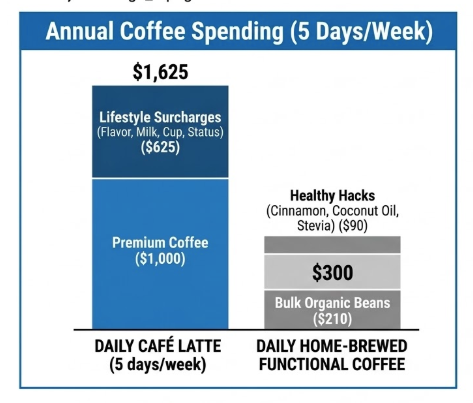
The Energy Drain: Those fancy lattes (pump-flavored, sweetened with syrups, made with whole milk) are often 300–500 calories and packed with 40+ grams of sugar. You might get a 30-minute caffeine high, but you are also guaranteed a severe insulin crash that will leave you feeling sluggish and hungry long before lunchtime.
3. Relying on Single-Serve Pods (The Convenience Fee)
Single-serve coffee makers (like Keurig or Nespresso) revolutionized home brewing with their “push-button” convenience. They promised gourmet flavor without the mess. But this convenience comes at a staggering structural cost.
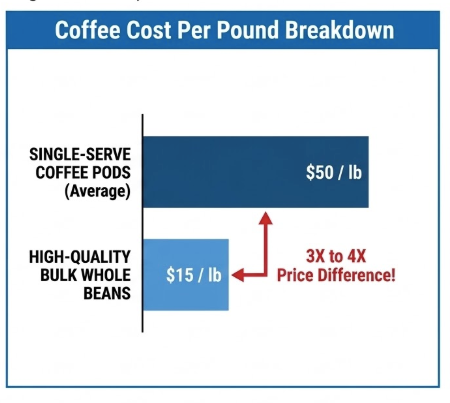
The Bank Drain: Coffee pods are perhaps the most expensive way to consume coffee at home. When you calculate the price per pound, pod coffee can cost $40 to $60 per pound, whereas buying high-quality, organic whole beans in bulk usually costs $12 to $18 per pound. If a family of two drinks two pods a day each, they are spending roughly **$800 a year** more than they need to.
The Energy Drain (Secondary): Pod coffee is pre-ground, which means it begins to oxidize and lose its potency (and antioxidant benefits) almost immediately. To get the same “kick,” people often find themselves needing two or three pods, increasing their caffeine intake unnecessarily and creating a cycle of reliance and jitters.
4. Drinking Coffee on an Empty Stomach
This is the ritual of the busy professional. You don’t have time for breakfast, so you substitute food with caffeine.
The Energy Drain: Coffee is highly acidic. Drinking it without food can irritate the stomach lining, trigger acid reflux, and cause nausea. More critically, it causes your body to release adrenaline and cortisol too rapidly, leading to the “jitters” followed by a sudden, severe exhaustion. Your body is trying to run on high-octane fuel (caffeine) without any actual baseline fuel (calories/macros).
The Bank Drain: Nausea, jitters, and acid reflux reduce productivity. Furthermore, that midday crash (caused by lack of breakfast) often drives people to purchase expensive “convenience foods” (like a $6 protein bar or a $9 sandwich) that they could have avoided with a simple, budget-friendly 25-cent oatmeal breakfast.
5. Using Coffee as a “Meal Replacement”
This is Option 4 taken to the extreme. You intentionally skip breakfast and rely on a high-calorie coffee “beverage” to keep you full until noon.
The Energy Drain: A “meal replacement” coffee (like a sweetened frappe) is an energy lie. You get 400 calories of pure sugar and simple fats. Your body burns through the sugar in 60 minutes, leaving you utterly depleted. Unlike a balanced meal of protein, complex carbs, and fats, your coffee “meal” provides zero sustained energy or cellular nutrition. You will be hungry, irritable, and unfocused by 10:30 AM.
The Bank Drain: Sweetened blended drinks are among the most expensive items on a café menu, often running $7 to $9 each. You are paying more for a dessert masquerading as a meal than you would for a healthy, satisfying homemade breakfast sandwich or smoothie.
6. Mismanaging the “Caffeine Window” (Drinking Too Late)
You’re tired at 3 PM, so you grab a cold brew to power through the rest of the workday. It seems like a smart productivity hack.
The Energy Drain: Caffeine has a half-life of roughly 5 to 6 hours. This means if you drink a potent cup at 3 PM, half of that caffeine is still actively blocking adenosine (the “sleepy” chemical) in your brain at 9 PM. While you might physically fall asleep, you won’t enter the deep, restorative “Slow Wave Sleep” your body needs for energy repairs. You wake up tired the next day, which means you need—you guessed it—more coffee. This is a perpetual energy debt cycle.
The Bank Drain: The 3 PM “crash coffee” is almost always a “dining out” purchase (a $6 cold brew). By correcting your morning sleep and timing, you eliminate the need for this expensive daily purchase.
7. Overdosing on Sugar Bombs (Pumps, Drizzles, and Powders)
The “flavor pump” is the most dangerous option in a coffee shop. Most people don’t realize what’s in it.
The Bank Drain: Most chains charge 50 to 80 cents per pump of syrup. If you get a “Vanilla Latte,” you are automatically paying an extra $1.50 to $2.00 just for liquid sugar. If you order “extra drizzle,” it’s another surcharge. By buying a sugar-free, unsweetened latte and adding your own flavor drops at home (which cost pennies per serving), you save **$10+ a week**.
The Energy Drain: This is the ultimate energy killer. A generic “Vanilla Latte” can have 35g of sugar. To give you perspective, the American Heart Association recommends no more than 36g of added sugar for the entire day for men (25g for women). That one latte uses your entire sugar budget. This triggers a massive insulin spike followed by a catastrophic crash. You aren’t tired from work; you are tired from a sugar coma.
8. Opting for Conventional “House Blends” (Pesticide Brew)
You buy the cheapest, biggest can of “House Blend” ground coffee at the grocery store to “save money.”
The Bank Drain (The Paradox): This seems like a savings win, but conventional, non-organic, pre-ground coffee is highly processed. Since it is pre-ground, it loses flavor quickly. You find yourself needing more scoops per pot to get the same taste. You end up buying coffee more frequently than if you bought dense, high-quality whole beans and ground them yourself as needed.
The Energy Drain: Conventional coffee is one of the most heavily chemically treated crops in the world. It is saturated with pesticides, herbicides, and fungicides that can irritate the gut and liver, stressing your body’s detoxification systems. A stressed, inflamed body is an exhausted body. Furthermore, cheap blends often use “Robusta” beans (which have double the caffeine of gourmet “Arabica” beans), leading to intense jitters and severe crashes.
9. Replacing Water with Coffee (The Dehydration Deficit)
You are “thirsty,” so you reach for a second cup of coffee rather than a glass of water.
The Energy Drain: Coffee is a mild diuretic, meaning it causes your body to lose fluids. But the bigger problem is behavioral: if you are always sipping coffee, you aren’t drinking water. A 2024 study highlighted that even mild dehydration (1-2% fluid loss) impairs cognitive performance, drains energy, and increases perceived fatigue. You aren’t tired from lack of caffeine; you are tired from lack of H₂O.
The Bank Drain (Indirect): Dehydration leads to poor focus, slower work, and mistakes. In the modern economy, your productivity is your money. If you have to work an extra hour a day just because your brain is foggy from dehydration, you are actively draining your earning potential.
10. The “Double-Dipping” Trap (Home & Away)
This is the budget-killer of the hybrid worker. You make a pot of coffee at home, but then, “just because you’re passing it,” you stop at a local café for a second cup “as a treat” for leaving the house.
The Bank Drain: You are paying twice. You’ve paid for the beans and utilities to make a great cup at home (roughly 30 cents), and then you pay an 18x markup (a $5.50 drip coffee + tip) for the privilege of a second cup elsewhere. If you “double-dip” three times a week, you are wasting **$800 a year** on a second cup that offers zero marginal productivity benefit.
The Energy Drain: This often leads to over-caffeination (400mg+ per day). Instead of a steady, productive focus, you enter a state of high-anxiety jitters. Your body is “too tired to sleep, yet too wired to work,” which is the single most exhausting state your nervous system can experience. Reclaiming control over your intake (e.g., sticking to one home-brewed cup) creates a smoother, more reliable energy profile.
Sources & References
-
National Coffee Association (NCA): Fall 2025 National Coffee Data Trends Report
-
American Heart Association (AHA): Added Sugars Guidelines and Recommendations
-
Journal of Clinical Sleep Medicine: The Effects of Caffeine Intake 0, 3, and 6 Hours Before Bed
-
National Institutes of Health (NIH): Cognitive and Physiological Consequences of Mild Dehydration (2024 Study Analysis)
-
Bureau of Labor Statistics: Historical Consumer Price Index for Food At Home vs. Food Away From Home (Coffee Markups Data)