

Key Points
- Micro-Niche Mastery: Success in 2026 isn’t about building “big” software; it’s about solving one specific, annoying problem for a small group (like SEO reports for plumbers) that they’ll gladly pay $29/month to automate.
- The $100 Launch: You no longer need a coding degree. By using no-code “wrappers” and AI APIs, you can build and launch a functional digital asset for less than $100, removing the traditional financial barrier to the software industry.
- Scalable Compound Wealth: Unlike freelancing, where you trade hours for dollars, Micro-SaaS creates Monthly Recurring Revenue (MRR). Once built, these tools serve 10 or 1,000 users with the same effort, growing your savings while you sleep.
We’ve all seen the “passive income” dream advertised on social media: sitting on a beach while money magically rolls into your bank account. The reality, of course, is that true passive income requires a massive upfront investment—either of cash or, more commonly for the average American saver, sweat equity. In 2026, the landscape of side hustles has shifted dramatically. While traditional methods like driving for rideshares or delivering groceries struggle under high fuel costs and oversaturation, a new titan has emerged: Micro-SaaS. A “Micro-SaaS” (Software as a Service) is a lean, niche software tool that solves one specific problem for a very specific audience. It is run by one person (you), often uses no-code or low-code tools, and has minimal operating costs.
Why is this the ultimate “My American Savings” side hustle? Because the business model is inherently scalable. Whether you have 10 customers or 1,000, your workload barely changes. According to recent 2026 developer ecosystem data, the global no-code market has breached $65 billion, proving that anyone with a good idea—not just software engineers—can now build a digital product.
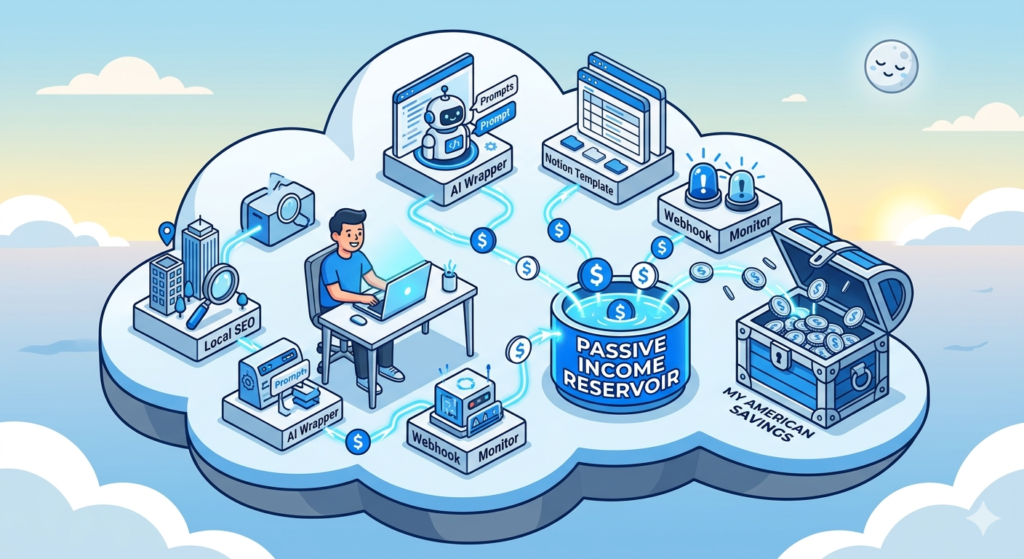
This isn’t about building the next Salesforce. It’s about building a “digital cash cow” that generates $500 to $5,000 per month in monthly recurring revenue (MRR) while you work your day job or sleep. If you have $100 and a weekend to spare, here are 7 Micro-SaaS ideas that are primed for success in the 2026 economy.
1. The “Local SEO Snapshot” Tool
The problem isn’t that small businesses (restaurants, plumbers, salons) don’t want to show up on Google. The problem is that they are too busy running their businesses to understand the nightmare that is “Local SEO” and “Google Business Profile” optimization.
The Solution (Micro-SaaS): A simple tool that a business owner can buy for $29/month. They type in their business name, and the tool generates a clean, one-page “Snapshot” report. This report automatically highlights errors: “Your phone number is inconsistent across the web,” “You are missing keywords in your description,” or “Your photos aren’t optimized.”
How it Generates Passive Income: You use no-code API tools (like Zapier) to connect Google’s free data to a clean reporting template (built in a tool like Bubble). Once the logic is set, the tool runs itself. The business owner pays you every month because the snapshot updates automatically, ensuring they stay optimized as competitors change.
2. “Shopify Snippet” Library for Niche Stores
E-commerce is more crowded than ever. A coffee bean dropshipper on Shopify is desperate for a competitive edge, but they can’t afford a $10,000 custom developer to add complex features to their store.
The Solution (Micro-SaaS): Instead of building a whole new app, you build a library of 10 pre-coded, copy-paste snippets for a specific niche (e.g., “The Luxury Watch Dropshipper Pack”). These snippets could add a custom “Inventory Countdown Timer,” a unique “Trust Badge” section, or a specialized “Gift Message” upsell box.
How it Generates Passive Income: You sell access to this library for a one-time fee of $79 or a “Updates Pack” for $15/month. The customer gets custom-code functionality for pennies, and you never have to write new code again once the snippets are perfected. You are selling a digital asset, not your time.
3. The “AI Prompt Pack” Wrapper for Niche Professionals
Generic AI tools are great, but they can be overwhelming. A real estate agent doesn’t want to learn “prompt engineering.” They just want a tool that helps them write 50 unique property descriptions that sound human and sell homes.
The Solution (Micro-SaaS): You build a “wrapper.” This means you use a no-code app builder (like Softr) to create a beautiful, private interface that connects to the OpenAI (ChatGPT) API in the background. Your interface has 5 simple input fields: “Property Type,” “Price,” “3 Key Features,” “Neighborhood Vibe,” and “Target Audience.” The real estate agent fills these out, hits enter, and gets a perfect description. They never have to type a single “prompt.”
How it Generates Passive Income: You charge $49/month for unlimited access to the “wrapper.” You pay OpenAI perhaps $0.02 for the backend computation of that prompt. Your margin is incredible, and the entire process is automated.
4. “SponsorSnap”: The Newsletter Ad Analyzer
Newsletter advertising is a massive growth industry for 2026. Companies are desperate to know where their competitors are placing ads and how well those ads are performing.
The Solution (Micro-SaaS): You build a database tool (using Airtable as the backend and Softr as the frontend) that manually or semi-automatically tracks the top 100 newsletters in a specific industry (e.g., “FinTech” or “Direct-to-Consumer Marketing”). Your tool identifies which brands are sponsoring, what their ad copy says, and provides a generic “Estimated ROI” score based on newsletter subscriber data.
How it Generates Passive Income: Marketing teams will happily pay $99/month to access this competitor data. While you might need to spend 2 hours a week updating the database with new sponsorships, the bulk of the tool’s value—and its recurring revenue—runs without your daily input.
5. “Coda” or “Notion” Template Packs for Freelancers
This is “Micro-SaaS Light.” Millions of freelancers manage their entire businesses using flexible database tools like Notion or Coda. However, setting these up efficiently is time-consuming and difficult.
The Solution (Micro-SaaS): You don’t build software; you build an incredibly advanced, interconnected freelancer operating system within Notion or Coda. It includes client CRM, project tracking, invoicing templates, expense logging, and a content calendar, all linked together using databases.
[Image showing a flowchart of how different databases link within a ‘Freelancer OS’ Notion template (CRM -> Projects -> Invoices -> Expenses).]
How it Generates Passive Income: You sell the template on marketplaces (like Gumroad) for a one-time fee of $129. Once the template is built and the documentation is clear, every single sale is 100% profit. Your only job is marketing, which you can often automate using social media scheduling tools.
6. The “Feedback Loop” Widget for No-Code Apps
The “no-code” movement means thousands of new apps are launched daily. One feature every single app needs is a “Submit Feedback” or “Report a Bug” widget.
The Solution (Micro-SaaS): You build a tiny, copy-paste JavaScript widget. An app creator embeds this snippet on their site. Their users see a clean “Provide Feedback” button. Clicking it opens a private, beautiful form where they can leave a message, submit a screenshot, and rate their experience. That data is then sent neatly to the app creator’s private dashboard (which you built).
How it Generates Passive Income: You charge $19/month per app. This is the ultimate “utility” Micro-SaaS. Once it’s installed, the creator forgets about it—and they continue to pay you monthly because they don’t want to lose their user feedback history.
7. “Zero-Code” Webhook Monitor
Low-code and no-code automation (using tools like Zapier and Make.com) is the lifeblood of modern small businesses. But what happens when an automation (a “Zap”) fails? Often, nothing happens. The business just loses data, and they don’t find out until days later.
The Solution (Micro-SaaS): You build a specialized monitoring tool. It provides a business with a single, custom URL. They add this URL to their automated workflows. If the workflow ever fails, the system automatically “calls” your URL, triggering an emergency alert (email or Slack message) to the business owner.
How it Generates Passive Income: This is “peace of mind as a service.” You charge $9/month for basic monitoring and $29/month for a “critical alert” package. It uses very little bandwidth or processing power, but it provides massive, automated value that customers will pay for indefinitely.
Final Thoughts: Building Your Own Savings
Micro-SaaS isn’t a get-rich-quick scheme. It is a strategic pivot away from trading your time for money. It is an investment in building an automated asset that works for you. By leveraging the low costs of the no-code revolution and focusing on solving one specific, painful problem for a niche audience, you can create a reliable, scalable income stream that secures your financial future while you sleep. Pick an idea, spend this weekend building the prototype, and launch your first digital cash cow.
Sources & References
-
State of No-Code: 2026 No-Code Ecosystem Market Data Report
-
MicroConf: The State of Independent SaaS 2026: Pricing and Retention benchmarks
-
Ahrefs SEO Data: Niche Keyword Volume Analysis for ‘Local SEO Tool’ and ‘AI Prompt Packer’
-
Shopify App Store Developers: Developer Revenue Data and Top App Category Trends 2026
-
Zapier Developer Platform: Webhook and Automation Failure Statistics (Internal Data Analysis)