
Key points
- Over half of U.S. households sacrifice between 100–500 square feet of living space to rarely used possessions — equivalent to losing an entire spare bedroom’s worth of value to clutter.
Studies indicate that clutter in the home is associated with higher levels of cortisol, the body’s primary stress hormone.
Cortisol spikes are higher in women related to household clutter than men.
Women are more likely to feel responsible for organizing and maintaining the household environment.
What’s more, clutter doesn’t just take up physical space — it quietly impacts mental health and productivity. A study funs that found that households with high levels of visible clutter experienced elevated stress levels, particularly among women. When countertops, closets, and garages are constantly overflowing, the brain interprets the environment as unfinished work, triggering anxiety and decision fatigue. Over time, this stress can affect sleep, focus, and even relationships. In other words, organizing isn’t just about aesthetics — it’s about creating a calmer, more functional home that supports your well-being without costing you extra money.
📊 Americans really feel the cost of clutter and organization:
| 💡 Clutter & Organization Facts (U.S.) | 📈 Impact |
|---|---|
| 🏠 Average American home has ~300,000 items | Too much stuff to manage effectively |
| 📦 54% households dedicate 100–500 sq ft to stored items | Valuable home space effectively “lost” |
| 🧠 80% of items kept are rarely or never used | Money wasted holding what we don’t use |
| ⏱️ Average person spends 2.5 days/year looking for lost items | Time lost that could be more productive |
| 💰 Households waste approx. $3,000/year buying duplicates or replacing lost items | Financial cost of poor organization |
These statistics make one thing clear: before you buy another storage bin or over-priced organizer, your real opportunity lies in smarter, free strategies that reclaim space and sanity.
Why Buying More Storage Isn’t Always the Answer
A new set of baskets, bins, or shelving might look pretty, but it often only hides the problem rather than solving it.
🏷️ Storage solutions can become part of the clutter problem — not the solution.
Before investing in more organizational products — especially costly ones — try understanding what’s taking up space and why:
-
Do you have things you don’t use but keep anyway?
-
Are items scattered because you don’t know where they belong?
-
Do duplicates exist because you can’t find the originals?
If the answer is “yes” to any of these, additional storage containers will only make your clutter more aesthetic — not functional.
Genius No-Cost Organizing Hacks That Work
Here are practical, budget-friendly ways to organize your home — without buying a thing.
1. “Put It Where It Belongs” — Assign Real Homes for Items
Too often clutter accumulates because items don’t have a designated place.
✔️ Solution: Spend 10 minutes per room identifying where things naturally belong — even if it’s a shelf you already have.
👉 Example:
-
Wraps, cords → put them in a specific drawer.
-
Kids’ craft supplies → store in a plastic shoebox you already own.
-
Seasonally used tools → designate a bin on a lower shelf.
Once you set a “home” for each category, everything has a place — and it’s easier to put back.
2. The “Touch It Once” Rule
A surprising reason clutter builds? Each time you touch something, you put it down somewhere “temporary.”
Instead, use the “touch it once” system:
📌 Mail → Sort immediately (file, recycle, bill)
📌 Laundry → Fold and return to drawer right away
📌 Kids’ toys → After play, each toy goes back to its assigned spot
This reduces the cycling of items through your home — and prevents piles from forming.
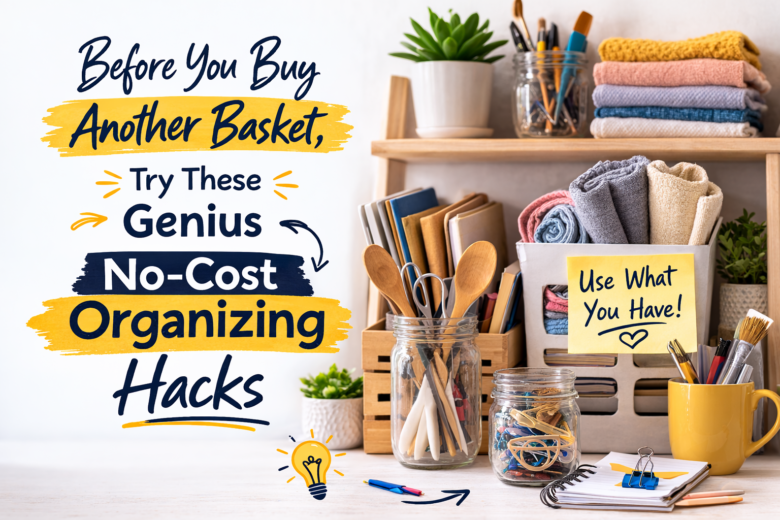
3. Use What You Already Have (Yes, Really!)
Instead of buying organizers, recycle what’s already in your home:
| Common Household Item | Creative Storage Use |
|---|---|
| Shoe boxes | Drawer dividers |
| Old baskets | Under-shelf storage |
| Jars | Pantry spice holders |
| Magazine holders | Canning lid and wrap storage |
| Egg cartons | Jewelry and small item trays |
Look around your pantry, closets, and basement. You’ll be surprised at what already serves as an effective organizing tool — with no extra cost.
4. The 4-Pile Declutter Method
Decluttering is the #1 step to better organizing — especially if you want to avoid buying new products.
Use four piles when sorting:
📍 Keep — Things you use often
📍 Donate — Items in good condition but no longer useful
📍 Recycle/Trash — Broken, worn, or useless items
📍 Unsure — Revisit in 1 week
This fast method helps reduce what needs organizing in the first place.
5. One Room 10-Minute Rule
Daily clutter builds up fast — but often, it takes just 10 minutes per day to maintain order.
Pick one room and set a 10-minute timer:
-
Clear surfaces
-
Reassign misplaced items
-
Fold or hang loose clothes
-
Wipe counters
Small, consistent efforts prevent major clutter crises later.
6. Swap, Don’t Shop
Before buying storage solutions, swap with friends or neighbors:
Exchanging storage containers, baskets, or shelving you already have — or their unused items — is basically free.
It’s a way to reuse and refresh your home without spending money.
Unexpected Benefits of Organizing Without Spending
Choosing to organize without buying new storage solutions doesn’t just save money — it has wider rewards:
💡 Saves Time
With everything in its place, you’ll spend less time searching for things. Studies show the average person loses 2.5 days a year hunting for lost items.
💰 Saves Money
Clutter forces you to repurchase items you already own — Americans waste around $3,000 a year this way.
🧠 Reduces Stress
Clutter is linked with stress and reduced wellbeing — a more organized home creates a calmer environment.
When It Might Be Worth Buying Storage
While this article champions no-cost solutions, there are cases where buying storage products makes sense:
✔️ When your home has already been decluttered
✔️ When you lack any functional storage
✔️ If you want sustainable long-term systems
Just be sure to declutter first, so you only buy products for things you actually use — not for twenty broken lamps in the basement.
Reclaim Your Space and Wallet
Before you grab another basket or bin on sale, pause and try these smarter organizing methods that cost zero dollars.
You’ll not only reduce clutter — you’ll:
✅ Save real money 👛
✅ Save time ⏰
✅ Reduce stress 🧘
✅ Reclaim valuable home space 🏡
Clutter costs Americans far more than we realize — in time, money, and stress — but the right habits, not products, fix it.
Ready to organize smarter? Start small, start today — and don’t spend a cent until you’ve given your current stuff a chance to shine.