
Disclaimer:
The information provided on MyAmericanSavings.us is for educational purposes only and should not be construed as financial, investment, or legal advice. Please consult with a licensed professional before making any financial decisions.
Key Points
- Hack Your Logistics: Save hundreds by booking split one-way tickets through cheaper hubs and using repositioning cruises as low-cost, all-inclusive transport.
- Unlock Local Pricing: Use a VPN to access destination-specific rates and buy local digital coupons before you leave to slash activity costs by half.
- Choose Experiences over Luxury: Exchange a few hours of work for free lodging and trade pricey “view” restaurants for scenic picnics to keep your budget intact.
We’ve all felt that irresistible itch. The one where your desk job starts feeling like a cage, your city seems too small, and you find yourself staring blankly at a world map on your wall. That’s the classic sign of wandering feet—a serious case of wanderlust.
The desire to explore new cultures and soak in breathtaking vistas is almost primal. But let’s be honest: in 2026, the dream vacation often collides head-on with the reality of inflation. According to the World Travel & Tourism Council (WTTC), global tourism reached a historic record last year, contributing $11.7 trillion to the global economy. While this growth is great for global recovery, it has also pushed the Average Leisure Travel Budget to a record high of $6,556 per household in 2026.
You don’t need a bigger salary to see the world; you need a better strategy. Recent data from the U.S. Travel Association shows that while overall travel costs have risen by 3% over the last year—driven by a 7.1% spike in airfares—lodging costs have actually dipped slightly. This means the travelers who stay flexible and “hack” their transport are the ones winning the vacation game. Forget the “book on a Tuesday” myths.
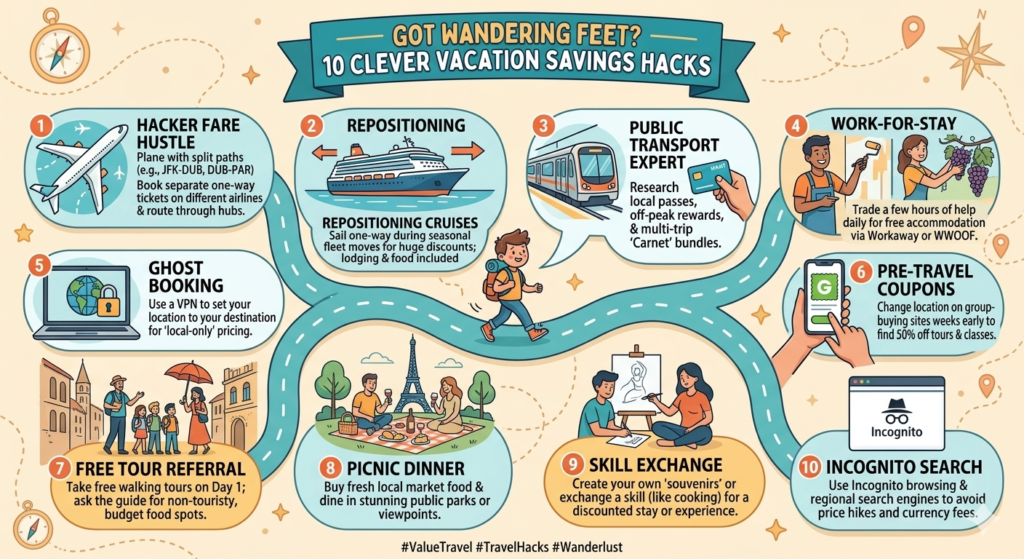
Here are 10 clever, human-tested vacation savings hacks to help you survive and thrive on the road.
 Related: How Families Can Save Money on Spring Vacations
Hack #1: The “Hacker Fare” Hustle – Beyond One-Way Tickets
The idea of booking two separate one-way tickets to save money isn’t new. But the clever way to do it is to think across different airlines and nearby airports. Comparison sites are great, but they often struggle to piece together complex combinations.
The Strategy: Say you want to fly from New York to London. Instead of just searching NYC to LON, look at the costs for flying from Newark (EWR) to Dublin (DUB) on one airline, and then a quick, cheap European carrier like Ryanair or EasyJet for DUB to London (LHR/LGW/STN). Sometimes, adding a little extra step can dramatically reduce the overall cost, especially during off-peak times or when specific budget carriers are running sales. You get to see an extra city (even if it’s just for an hour or two) and your wallet says a giant “thank you.”
Hack #2: Leverage “Repositioning Cruises” to Get Home
You’ve probably heard of a cruise. You’ve probably never considered a repositioning cruise as a way to save money on a one-way trip home. These cruises are not designed as a vacation but as a logistical move. The cruise lines are moving their massive ships from, say, the Mediterranean (at the end of the summer) to the Caribbean (for the winter).
The Strategy: They need to fill these ships, but since the routes are unusual and often have few port stops, they are offered at incredible, bargain-basement prices. You could find a 10-day crossing from Rome to Florida for less than the cost of a last-minute flight! Yes, you have a 10-day sea voyage, but the food and your cabin are included. It’s an adventure in itself, and it’s one of the most cost-effective ways to get yourself (and your luggage!) across an ocean. It’s a literal “get home for almost nothing” card that also comes with an all-you-can-eat buffet.
Hack #3: Become an “Expert Witness” on Public Transportation
This sounds strange, but hear me out. Many public transport systems are far more complex and offer better savings than a standard 24-hour pass.
The Strategy: Don’t just buy the pass. Become an expert on its specifics. Is there a family pass that’s a better deal? Do they offer a discount for travel after 10 a.m. (off-peak)? Is there a ticket called a “carnet” (like in Paris), where you buy 10 single tickets for a discounted price, and it doesn’t expire for a year?
Before you arrive, do a deep dive into the local transport authority’s website. For example, in London, using an Oyster card or your contactless bank card automatically caps your daily spending. In Venice, buying a multiple-day water bus (Vaporetto) pass is a must-save. In Lisbon, getting a rechargeable “Viva Viagem” card lets you load money and pay for each trip at a cheaper rate. This granular knowledge can save you dozens of dollars over the course of a week.
Hack #4: Work-for-Your-Stay with “Workaway” or “WWOOF”
This is a game-changer for long-term travelers and those with a flexible schedule. It’s not a hack to save pennies; it’s a way to eliminate one of your biggest costs altogether: accommodation.
The Strategy: Sites like Workaway and WWOOF (World Wide Opportunities on Organic Farms) connect travelers with hosts who need help with various projects. You typically work for about 4-5 hours a day (anything from farming to web design, hostel work, or construction) in exchange for free accommodation and, usually, free food. It’s a magnificent way to immerse yourself in a culture, learn new skills, and meet incredibly interesting people. It transforms you from a “tourist” into a “participant,” and it can reduce your accommodation cost to absolute zero.
Hack #5: Mastering the Art of “Ghost Booking” for Local Discounts
Local discounts are everywhere, but you rarely see them as a tourist. This hack is about creatively positioning yourself as a “local-in-the-know.”
The Strategy: Many sites and apps use your IP address to determine where you’re from and what price to show you. You can often access a completely different (and cheaper) pricing tier by using a VPN (Virtual Private Network) to change your virtual location. But even simpler is the “Ghost Booking” technique for restaurant reservations.
Sites like TheFork (common in Europe) offer substantial discounts (20-50% off your food bill!) at many fantastic restaurants. But these discounts are often for specific, less popular times, and you must book through the platform. Before you head out for dinner, don’t just find a place on Google Maps. Search TheFork or a similar local reservation app for your neighborhood right now. Book a table for that evening at a place offering a 30% discount. It costs you nothing, you get a great meal, and you instantly save a third of your food budget.
Hack #6: Buy Group Coupons… Before You Travel
Group-buying sites like Groupon, LivingSocial, or their local equivalents are fantastic for deals in your own city. Why not use them for your destination?
The Strategy: A few weeks before your trip, change your city on Groupon (or the leading local equivalent for your destination) to where you are going. Suddenly, you’ll see deals for boat tours, museums, cooking classes, spa treatments, and even multi-day excursion packages. You can buy these for your travel dates and save huge percentages off the retail price. It requires planning, but pre-purchasing activities at 40-60% off can be one of the biggest money-savers of your entire trip. Just be sure to read the fine print about booking windows and blackout dates.
Hack #7: Join the “Free Walking Tour” Revolution (With a Twist)
Free walking tours are now a staple in almost every major city. They are a brilliant invention – you get an enthusiastic guide and only pay a tip at the end. But the real hack isn’t just taking the tour; it’s how you use it.
The Strategy: Most cities will have multiple free tours focused on different things – the historic old town, street art, a specific historical period (like communist-era history). Take one of these on your first or second day. Then, the clever part: instead of just saying “thanks” and leaving, introduce yourself to the guide and ask for a local, budget-friendly recommendation for lunch. These guides are usually young, passionate locals who know all the best, non-touristy spots. A great tip here could lead you to a family-run café where a delicious lunch costs half of what you’d pay near a major monument.
Hack #8: The “Picnic Dinner” in a Stunning Location
Eating out for every single meal is a guaranteed way to bleed your budget dry. This hack is simple, incredibly enjoyable, and turns dining into an experience.
The Strategy: Find the most beautiful, iconic viewpoint or park in the city. The Eiffel Tower at sunset, a park overlooking the hills of Rome, a beach at dusk. Then, instead of going to a restaurant with a view (where the view is part of the high price), head to a local supermarket or market first. Buy fresh bread, cheese, a bottle of wine (in countries where it’s inexpensive and legal to drink in public), some fruits, and a delicious dessert. Take it all to your chosen spot and have a picnic. The food is fresh and cheap, the “ambience” is better than any 5-star restaurant, and you’re probably spending 10% of what a sit-down meal would cost.
Hack #9: Turn Your Skills into Your Own “Souvenir Economy”
Souvenirs can be expensive, and they often end up cluttering your home. This hack flips the script and turns you into the creator of your own memories.
The Strategy: Think of a small skill you have that you can easily take with you. Are you good with a camera? A skilled artist? Do you enjoy writing? Instead of buying mass-produced keychains, challenge yourself to create one unique, personal “souvenir” each week of your trip. Maybe it’s a series of five stunning photographs, a sketchbook with a drawing from each new location, or a beautifully crafted poem about an experience. This forces you to be more present, you create something of genuine, lasting value, and you save all that money that would have been spent on things you’ll forget about in a year.
Hack #10: Embrace the “Swap Shop” Economy
One of the most surprising and underutilized ways to get free or heavily discounted experiences is to lean into the concept of a skills or goods exchange.
The Strategy: This works best if you’re staying in hostels, but can work in Airbnb stays too. Hostels are hubs of diverse people and skills. If you’re a good cook, offer to make a large communal dinner for other guests if the hostel can waive your stay for that night (or even just part of it). If you’re a yoga instructor, offer a free sunset class on the hostel roof in exchange for a discounted tour booking. You’d be amazed how many independent hostels are open to these creative swaps. It never hurts to politely ask, and it can open doors and build communities you’d otherwise miss.
The Psychology of a “Saver” vs. a “Spender”
Why do some people come home from vacation feeling refreshed, while others feel “broke”? It comes down to Value-Based Spending.
Research in behavioral economics suggests that we get more “happiness units” from many small treats than one giant luxury. Instead of one $500-a-night hotel stay, try five nights in a charming $80 guesthouse and use the remaining $420 for ten incredible local experiences. This “diversification of joy” is the secret weapon of the world’s most frequent travelers.
| Expense Category | Traditional Cost | Hack Cost | Total Savings |
| Flights (Long Haul) | $1,200 | $750 (Hacker Fare) | $450 |
| Accommodation | $150/night | $0 (Workaway) | $1,050 (per week) |
| Dining | $60/day | $20 (Picnic/Local) | $280 (per week) |
| Tours | $50/ea | $10 (Tip-based) | $40 |
Your Adventure Awaits
The world is a book, and those who do not travel read only one page. But you don’t need to buy the most expensive edition of that book to enjoy the story. By using these ten hacks, you are choosing to prioritize experience over display.
Wandering feet are a blessing. Don’t let a spreadsheet stop you from seeing the sunrise over the Himalayas or the neon lights of Tokyo. Start small—try just two of these hacks on your next trip—and watch how much further your money goes.
Sources & Data References:
-
Hotel News Resource: American Traveler Financial Sentiment & Budget Trends 2026.
-
U.S. Travel Association: Travel Price Index (TPI) Monthly Report – March 2026.
-
NerdWallet: Travel Inflation & Price Tracker 2026.