

How I Saved for My Dream Vacation Without Feeling Broke

February 16, 2026 By Jessica the Saver

For the longest time, I believed dream vacations were only for people with extra money sitting around. Every time I looked at flight prices or hotel rates, I quietly closed the tab and told myself, “Maybe next year.” But I was tired of postponing experiences I truly wanted.

At the same time, I knew I wasn’t alone. According to data from the U.S. Travel Association, travel spending has continued to grow in recent years, showing that people are prioritizing experiences even during uncertain economic times.

Meanwhile, a survey by Bankrate found that many Americans struggle to cover unexpected expenses, which made me realize something important: if I didn’t plan intentionally, my vacation would always feel “out of reach.”

So instead of waiting for the “perfect financial moment,” I created a realistic savings strategy. And the best part? I did it without feeling broke, restricted, or miserable.

Here’s exactly how I did it.
Step 1: I Gave My Dream a Real Number

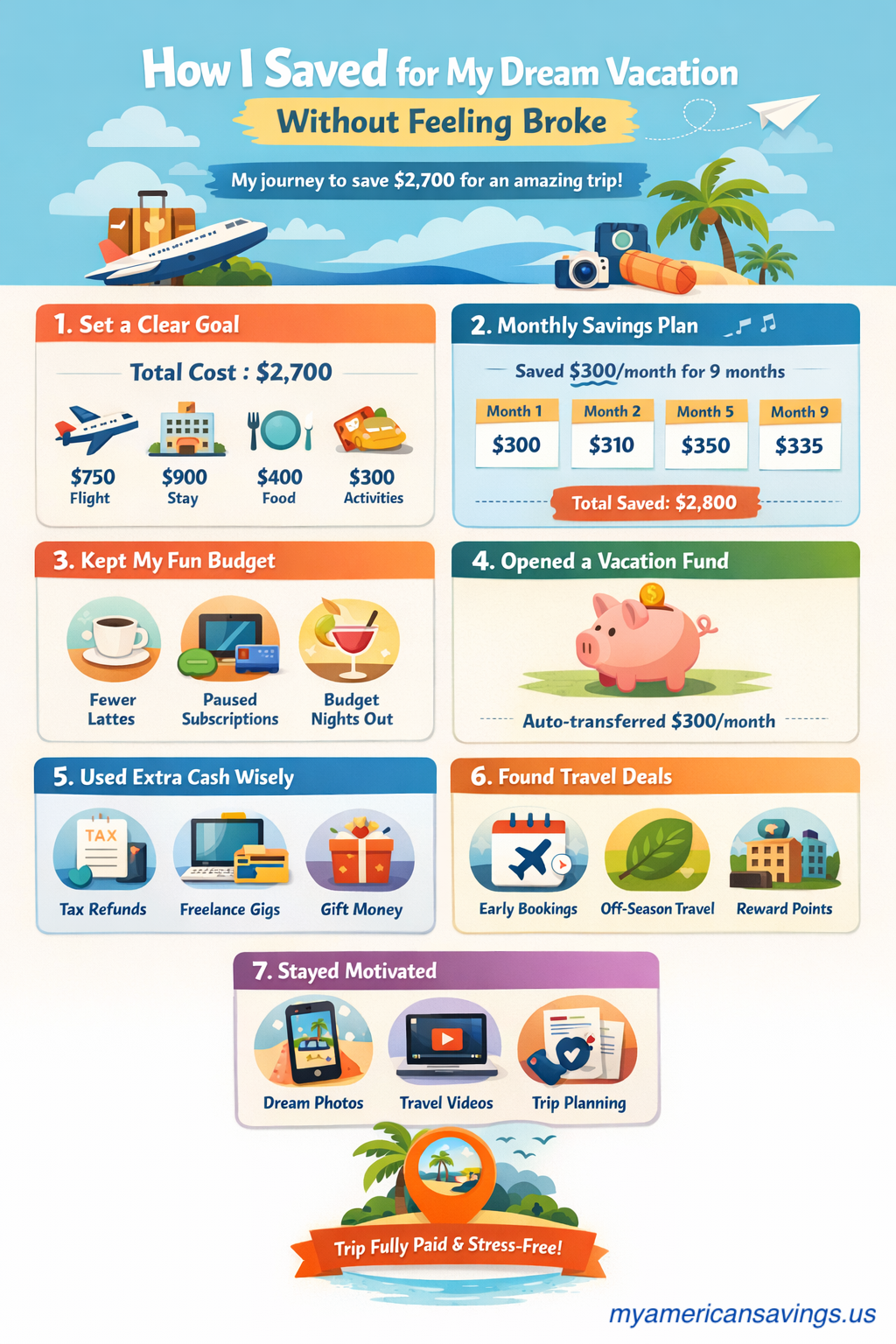
The first thing I did was stop saying, “I want to travel someday.” That was too vague. I chose a destination, researched flights, accommodations, food, and activities, and calculated an estimated total cost.

✈️ My Vacation Cost Breakdown

🏷️ Expense Category 💵 Estimated Cost
🛫 Round-trip Flight $750
🏨 Accommodation (5 nights) $900
🍽️ Food & Dining $400
🎟️ Activities & Tours $300
🚕 Local Transportation $150
🧳 Miscellaneous Buffer $200
💰 Total Goal $2,700

Step 2: I Broke It Down Into Monthly Targets

Instead of obsessing over $2,700, I divided it by 9 months. That came out to $300 per month. $300 felt achievable. It was no longer overwhelming—it was simply a monthly commitment.

💰 Monthly Savings Plan

📅 Month 🎯 Target Savings 💵 Actual Saved
🗓️ Month 1 $300 $320
🗓️ Month 2 $300 $280
🗓️ Month 3 $300 $310
🗓️ Month 4 $300 $300
🗓️ Month 5 $300 $350
🗓️ Month 6 $300 $290
🗓️ Month 7 $300 $305
🗓️ Month 8 $300 $310
🗓️ Month 9 $300 $335
🏁 Total $2,700 $2,800

Seeing progress every month motivated me more than I expected.


Step 3: I Stopped Cutting Everything (That Was My Old Mistake)

In the past, I tried extreme budgeting. No eating out. No small treats. No fun purchases.

It always failed.

This time, I didn’t eliminate joy—I optimized it.

Instead of:

  • Cutting coffee completely

  • Cancelling every subscription

  • Saying no to every social event

What i did?

  • Reduced dining out from 4 times a week to 2

  • Paused one unused subscription

  • Looked for happy hour deals instead of full-price dinners

Small adjustments created real savings without making me feel deprived.


Step 4: I Created a “Vacation-Only” Account

One of the smartest things I did was open a separate savings account just for this trip.

Every payday, I automatically transferred $300. I treated it like a bill—non-negotiable.

Psychologically, this changed everything. The money wasn’t “extra.” It wasn’t available to spend. It had a purpose.

And watching that account grow? That was addictive in the best way.


Step 5: I Used Windfalls Strategically

Any unexpected money didn’t get absorbed into daily spending.

Tax refund? → 50% to vacation fund.
Freelance payment? → Direct deposit into vacation savings.
Birthday money? → Added immediately.

This accelerated my progress without touching my regular budget.


Step 6: I Made Travel Part of My Daily Motivation

Instead of feeling restricted, I constantly reminded myself why I was saving.

  • I made my destination my phone wallpaper.

  • I watched travel vlogs about the location.

  • I researched restaurants I wanted to try.

Every small sacrifice felt purposeful. I wasn’t “missing out.” I was choosing something bigger.


Step 7: I Looked for Smart Travel Savings

Saving was only half the strategy. Reducing the total cost mattered too.

Here’s where I cut expenses without lowering the experience:

🧳 Smart Travel Savings I Used

Strategy How It Helped
Booking flights 3 months early Lower airfare
Traveling during shoulder season Cheaper hotels
Using travel reward points Reduced flight cost
Choosing a centrally located hotel Saved on transportation
Pre-booking activities online Avoided tourist markups

These small travel hacks shaved nearly $300 off my original estimate.


The Biggest Mindset Shift

The real breakthrough wasn’t the budgeting spreadsheet.

It was understanding that I didn’t have to feel broke to save money.

  • Kept a small “fun budget” each month

  • Allowed occasional treats

  • Focused on progress, not perfection

And because I wasn’t miserable, I stayed consistent.

Consistency beats intensity every time.


What Happened When I Finally Took the Trip

When I boarded that plane, something felt different.

I wasn’t anxious about credit card bills.
I wasn’t calculating interest in my head.
I wasn’t worried about “how I’d pay it off later.”

The trip felt lighter because it was fully funded.

And here’s the surprising part: saving for the vacation was almost as satisfying as taking it.


What I’d Tell Anyone Who Feels Like Travel Is “Too Expensive”

You don’t need:

  • A massive salary

  • A bonus

  • A lucky break

You need:

  • A clear number

  • A realistic timeline

  • A system that doesn’t make you miserable

Saving for my dream vacation didn’t make me feel broke. It made me feel intentional.

And once I realized that experiences don’t require debt—just planning—I stopped postponing the life I wanted.

If you’re waiting for the “right time” to travel, this is your sign: Start with the math. Break it down. Automate it. Protect your joy.

Your dream trip is probably closer than you think!

Leave a Reply

Your email address will not be published. Required fields are marked *