
Key Points
- Strategy Over Luck: Success depends on a “Strict Inventory First” approach—using what you already have to supplement a $50 list of versatile, raw ingredients rather than expensive pre-packaged kits.
- The Power of “Anchor” Ingredients: Low-cost, high-volume staples like cabbage, potatoes, and lentils act as nutritional foundations that can be transformed into multiple different meals throughout the week.
- Zero-Waste Efficiency: To stay under budget, you must utilize “scraps”—such as turning chicken bones into a nutrient-dense broth that serves as the base for two days of family-sized soups.
Let’s talk about the grocery store. It used to be a quick stop; now, it feels like a high-stakes tactical mission. For many American families, walking down the center aisles is an exercise in sticker shock. The data tells a stressful story: as of early 2026, the USDA’s Thrifty Food Plan estimates that a family of four must spend at least $230 to $250 per week just to maintain a basic, nutritious diet at home. That’s a staggering figure, especially when wages aren’t keeping pace. But what if I told you there’s a way to feed a family of four—with variety, nutrition, and without feeling deprived—for just $50 a week?
It sounds impossible. It sounds like all you’d eat is ramen. I thought so, too, until our family was forced by necessity to try the “$50 Challenge” during a particularly tight financial season. What i discovered wasn’t a miserable existence of beans and rice, but rather a masterclass in strategy, creativity, and radical efficiency. The $50 Weekly Grocery Challenge isn’t just about spending less; it’s about changing how you see food.
Here is my battle-tested, budget-friendly meal plan and strategy to feed your family of four for $50 this week.
 Related: Broke but Hungry? 20 Cheap Foods That Stretch Every Dollar
The $50 Philosophy: It’s All About Strategy
You cannot attempt this challenge without a plan. If you wander into a grocery store with $50 and “vibes,” you will run out of money before you reach the dairy aisle. Success relies on three foundational rules:
-
Strict Inventory First: You must know what you already have. Half a bag of rice? Two frozen chicken breasts? A can of diced tomatoes? This is your “bonus budget.” Every meal is designed to maximize what is already in your pantry.
-
The “Ingredient, Not Meal” Mindset: Do not buy “Taco Kits.” Buy tortillas, ground beef (or lentils), and spices. You are buying raw components that can be used in multiple ways throughout the week.
-
Zero-Waste Commitment: When you are on a $50 budget, throwing away leftovers or letting a head of lettuce go slimy in the crisper isn’t just wasteful—it’s a financial failure. Your plan must account for utilizing every single scrap.
The $50 Master Shopping List
This list is based on average 2026 prices at discount grocers (like Aldi, Walmart, or WinCo). Pricing varies by region (NYC is not Kansas), but these items represent the most potent “nutritional bang for your buck” on the market.
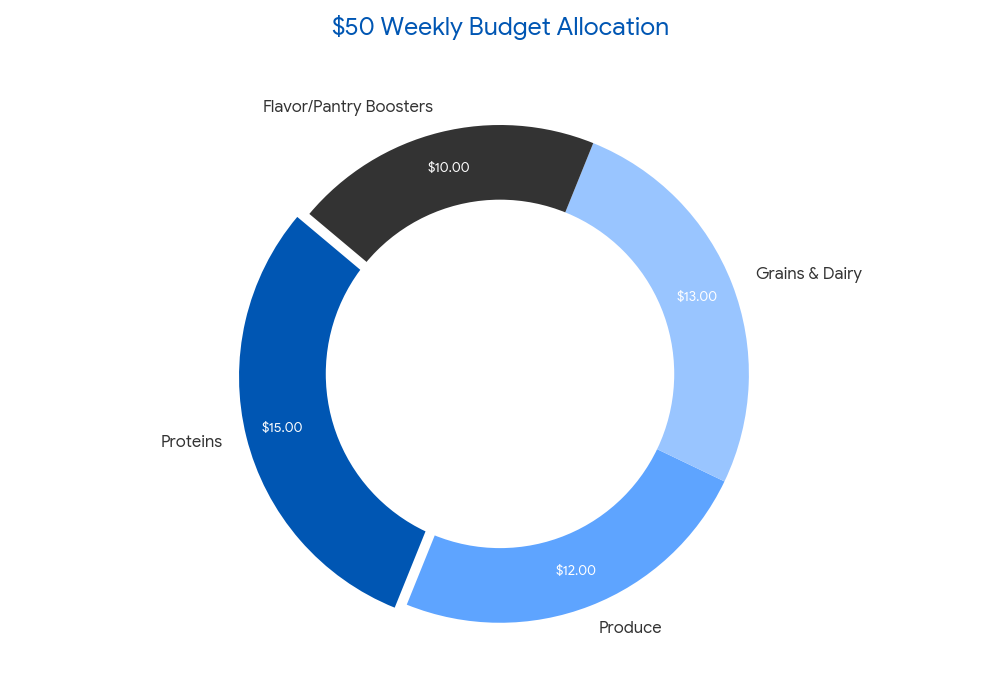
Proteins ($15.00)
-
Large Eggs (18-count): $4.50
-
Family Pack Chicken Drumsticks or Thighs (approx. 4 lbs): $7.50
-
Dried Lentils (1 lb bag): $1.50
-
1 Can Black Beans (Store Brand): $0.80
-
1 Can Chickpeas/Garbanzo Beans (Store Brand): $0.70
-
(Utilizing Pantry: Perhaps that half-pound of frozen ground beef or leftover pork chop)
Produce: The “Long-Lasting” Rule ($12.00)
-
Russet Potatoes (5 lb bag): $3.50
-
Whole Carrots (2 lbs): $2.00
-
Onions (3 lb bag): $2.20
-
Whole Head of Green Cabbage: $2.30
-
Bananas (1 large bunch): $1.50
-
(Utilizing Pantry: Leftover frozen veggies or that half-onion)
Grains & Dairy ($13.00)
-
Store Brand Sliced White/Wheat Bread: $1.80
-
White Rice (3 lb bag, non-fancy): $3.20
-
Pasta (1 lb, any shape): $1.10
-
Oatmeal (Old Fashioned, large container): $3.90
-
Store Brand Milk (1 gallon): $3.00
-
(Utilizing Pantry: The last cup of quinoa, a few tortillas, or some flour)
Flavor & Pantry Boosters ($10.00)
-
Pasta Sauce (1 jar, basic): $1.80
-
Peanut Butter (1 jar): $2.80
-
Bulk Spices/Seasoning (e.g., Taco Seasoning or Garlic Powder): $2.40
-
Vegetable or Chicken Bouillon (Cube or Jar): $3.00
-
(Utilizing Pantry: Salt, Pepper, Oil, and existing spices)
The Family-of-Four Meal Plan
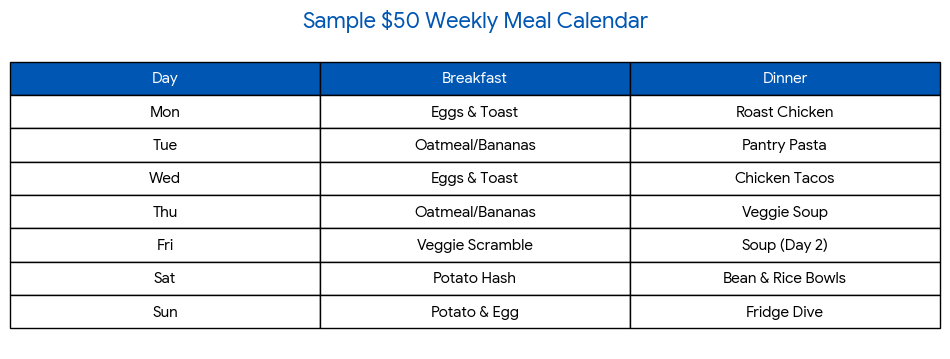
This is a fluid, ingredient-based plan. It’s not meant to be rigid; if you don’t feel like having cabbage on Tuesday, swap it. The key is that all the components are available.
Breakfasts: Simple, Fast, and Filling
-
Monday & Wednesday: Scrambled Eggs (3 eggs total for the family) and Toast.
-
Tuesday & Thursday: Oatmeal (cook a big batch) topped with sliced Bananas.
-
Friday: A “Clean-Out-The-Fridge” Scramble (last 2 eggs, leftover veggies, some potato).
-
Weekend: Homemade Potato Hash (using those 5 lbs of potatoes) with one fried egg on top per person.
Lunches: The “Leftover & Component” Strategy
-
Rule of Thumb: We never cook a specific lunch. Lunch is about speed and using what is available.
-
Monday, Wednesday, Friday: Leftovers from the previous night’s dinner.
-
Tuesday & Thursday: Peanut Butter (and perhaps a banana slices) Sandwiches. A simple, packed lunch for school or work.
-
Saturday: Cabbage and Carrot “Pantry Slaw” (using the head of cabbage, carrots, and a bit of oil/bouillon/vinegar) served with the last of the bread.
-
Sunday: “Fridge Dive.” Finish the leftover rice, the last tortilla, any remaining bean mixture.
Dinners: The Big Anchors
This is where your strategy must shine. Your goal is to cook one large meal that provides dinner that night and lunch the next day.
Night 1: Roasted Chicken & Potatoes
-
The Meal: Roast all 4 lbs of chicken drumsticks/thighs. Season generously with salt, pepper, and garlic powder. Roast 2 lbs of potatoes (cubed) alongside them.
-
The Save: Carve all meat off the bones before serving. Serve half the meat and all the potatoes for dinner. Reserve the other half of the cooked meat for Night 3. Save all the bones!
Night 2: Big Batch “Pantry Pasta”
-
The Meal: Cook the 1 lb of pasta. Sauté half an onion and a minced carrot in a little oil (or water, if oil is tight). Add the jar of pasta sauce. Stir in the can of chickpeas. Toss with pasta.
-
The Save: This makes a huge volume. Eat half for dinner; pack the other half for lunch on Monday.
Night 3: Shredded Chicken & Cabbage “Tacos” (or Rice Bowls)
-
The Meal: In a large skillet, sauté half the green cabbage (shredded) and one onion until soft. Add the reserved cooked chicken from Night 1, a big spoonful of bouillon (made into broth), and plenty of taco seasoning. Simmer until the liquid is absorbed.
-
The Save: Serve over rice (or in tortillas if you have them in the pantry). This creates a massive, flavorful, nutrient-dense volume that tastes nothing like “budget food.” Eat half; save half for lunch on Wednesday.
Night 4: The 2-Day Soup Project (Pantry Vegetable & Bone Broth)
-
The Meal (Day 1): Take the bones from Night 1. Boiled them with the bouillon, the onion scraps, the other head of green cabbage (chopped), the rest of the carrots (chopped), and the last 3 lbs of potatoes (diced). Simmer for 3-4 hours. This makes gallons of nutritious, comforting soup.
-
The Save: This provides dinner for two nights (Night 4 and Night 5) AND lunch on Friday. It only costs the ingredients you already bought.
Night 5: The Soup Continues
-
The Meal: Serve the soup again. To make it different, toast the last few slices of bread into croutons and serve with a few boiled eggs.
Night 6: Black Bean & Rice “Fiesta Bowls”
-
The Meal: In a large skillet, cook 2 cups of white rice. Sauté the last half of the onion with taco seasoning. Stir in the can of black beans and any remaining corn/frozen veg from your pantry.
-
The Save: Top with the rice and a fried egg per person. This is a complete protein, massive in volume, and costs almost nothing. Save the rest for lunch on Sunday.
How to Master Zero-Waste Kitchen Efficiency
Your $50 budget is built on efficiency. Here is how to ensure nothing goes to waste:
-
Bone Broth is King: Don’t throw away any animal bones or sturdy vegetable scraps (onion skins, carrot peelings). Boil them with water and a bouillon cube for 4-5 hours. That rich broth is the base for your entire soup strategy. It contains gelatin, collagen, and nutrients that keep your family full.
-
Cabbage is Your Secret Weapon: Cabbage is often under $1.00 per pound. A single head is dense and heavy, offering massive bulk. It can be sautéed with taco seasoning (Night 3), boiled in soup (Night 4/5), or eaten raw as a slaw (Saturday Lunch). It lasts for weeks in the fridge.
-
Lentils: The Invisible Bulk: Dried lentils are a nutritional powerhouse (high protein, fiber, and iron) and extremely cheap. If your $5k family pak of chicken looks small, cook a cup of lentils and stir them into the Night 3 chicken/cabbage mix. They absorb the flavor and instantly double the volume of the meat without changing the taste.
Sources & References
- Bureau of Labor Statistics: Consumer Price Index – Food At Home (Historical Data)
-
World Health Organization: Protocols for Low-Cost, Complete Nutrition
-
Pantry Audit Protocols: Best Practices for Household Inventory Management (Independent Financial Study)