

Key Points
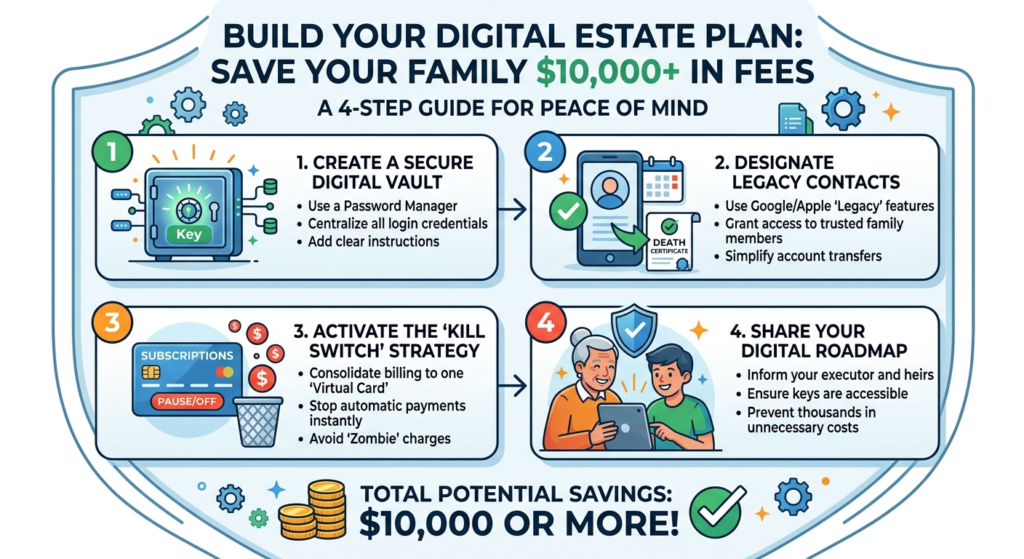
- Create a “Digital Off-Switch”: Use a password manager with a Legacy Contact feature. This ensures your family isn’t locked out by two-factor authentication and can access the “Master List” of your accounts to shut down expensive services immediately.
- Use a “Financial Kill Switch”: Consolidate all recurring digital bills onto a single Virtual Card. This allows your family to pause or close every automated payment in one click, preventing thousands of dollars in “Ghost Subscription” leaks from a frozen bank account.
- Automate Your “Inactive” Status: Activate Google’s Inactive Account Manager and Apple’s Legacy Contact. These tools automatically grant your heirs access to your email and cloud billing receipts after a period of inactivity, bypassing months of legal paperwork.
In early 2026, the average American household manages an all-time high of 12 to 15 digital services, ranging from cloud storage and streaming to automated grocery deliveries and professional software suites. According to the 2026 Digital Legacy Report, over $1.5 billion is lost annually to “Ghost Subscriptions”—recurring payments that continue to drain bank accounts and credit lines long after a primary account holder has passed away. If a family takes just six months to settle an estate, these invisible leaks can easily siphon off thousands of dollars in “phantom” expenses that provide zero value to the grieving survivors.
The modern estate isn’t just about physical property or gold watches anymore; it is written in code and hidden behind encrypted passwords. When we talk about leaving a legacy, we usually think of life insurance or real estate. However, in our hyper-connected era, the most immediate financial gift you can give your family is a “Digital Off-Switch.” Without a clear plan, your grieving loved ones will be forced to play a high-stakes game of whack-a-mole with automated billing cycles, often while dealing with frozen bank accounts and unresponsive customer support bots.
This guide is designed to help you build a Digital Estate Plan that protects your family from losing $10,000 or more in unnecessary fees. We will move past the technical jargon and focus on a humanized, step-by-step strategy to ensure your digital footprint stops costing your family money the moment you are no longer there to manage it.
 Read: The Ultimate Guide to Retirement Savings: Building Your Future in 2026
The Anatomy of a $10,000 Ghost Leak
To understand how these costs balloon so quickly, we have to look at the “hidden” side of the subscription economy. It isn’t just the $15 Netflix bill. By 2026, many of us have high-tier cloud storage plans ($20/month), premium health and fitness memberships ($40/month), professional LinkedIn or Adobe suites ($60/month), and automated “Subscribe & Save” shipments for household goods ($100+/month).
When a person passes away, banks often freeze individual accounts to prevent fraud. However, recurring “authorized” charges on credit cards frequently bypass these initial freezes. If your family doesn’t have the login credentials to cancel these services, they must contact every individual company with a death certificate—a process that can take weeks per service. In the meantime, the “Ghost Subscriptions” keep running. If you have a business-class software suite or high-end insurance products with automated renewals, that $10,000 threshold is crossed much faster than you’d think.
The “Digital Vault” and Password Hygiene
The single greatest hurdle for a grieving family is the “Login Wall.” In 2026, security measures like Two-Factor Authentication (2FA) have made it nearly impossible for a spouse or child to “guess” their way into your accounts. If the 2FA code is sent to your locked phone, your family is essentially locked out of your financial life.
The humanized solution is to use a Password Manager with a “Legacy Contact” feature. Services like 1Password and Dashlane allow you to designate an emergency contact who can request access to your vault. If you don’t approve the request within a set timeframe (such as 7 days), the vault opens for them. This ensures that your family has the keys to the digital kingdom without compromising your privacy while you are still here.
Beyond just passwords, your Digital Vault should contain a “Master List” of every recurring payment. This isn’t just for streaming. It should include your web hosting, your annual credit card fees, and even your digital gym key. Think of this list as a roadmap for your family to follow so they aren’t searching through thousands of emails trying to find out where the money is going.
Setting Up “Dead Man Switches” in 2026
A “Dead Man Switch” sounds grim, but in digital terms, it is an act of profound love. Most major tech ecosystems now have built-in tools to handle your data and subscriptions automatically if your account becomes inactive.
Google’s “Inactive Account Manager” is the gold standard for this. You can instruct Google to notify a trusted friend or family member if you haven’t logged in for three months. You can even choose to give them access to your Gmail and Google Drive, which is where 90% of your subscription receipts likely live. By giving your family access to your email, you are giving them the “Search” tool they need to find every billing confirmation and “Cancel” button in your digital life.
Apple’s “Legacy Contact” works similarly for iPhone users. It provides a unique recovery key that your family can provide to Apple along with a death certificate to unlock your iCloud. This prevents your family from losing precious photos, but more importantly, it allows them to manage your “App Store Subscriptions,” which are notoriously difficult to cancel from the outside.
The Financial “Kill Switch” Strategy
One of the most effective ways to prevent ghost subscriptions is to centralize your billing. If your subscriptions are scattered across three different credit cards and two different bank accounts, the cleanup process is a nightmare.
In 2026, financial experts recommend using a “Subscription-Only” virtual card. Services like Privacy.com or even the built-in virtual card features from major banks allow you to create a card specifically for recurring bills. The beauty of this strategy is that your family only needs to “Pause” or “Close” one single card to stop every single ghost subscription at once. This acts as a manual “Kill Switch” that saves them from having to call 20 different companies during the first week of mourning.
Additionally, you should ensure that your “Authorized Signers” on bank accounts are up to date. If you have a joint account, your spouse can usually keep it open and manage the bills. However, if the account is in your name only, it will likely be frozen, causing “Late Fees” and “Overdrafts” to pile up as automated bills continue to hit the account. Moving your recurring bills to a joint account or a designated virtual card is a simple move that prevents a massive headache later.
Dealing with the “Physical-Digital” Hybrid
We often forget about the subscriptions that have a physical component. “Subscribe & Save” programs for coffee, pet food, or vitamins can be some of the most expensive leaks. If a family isn’t living in the same home, these packages can pile up on a porch for weeks, with the credit card being charged every time.
Your Digital Estate Plan must include a “Subscription Audit” twice a year. This is a 15-minute task where you look at your credit card statement and identify any service that ships a physical product. Mark these clearly in your Master List. For your family, the stress of dealing with “returned shipments” and “undeliverable mail” is an emotional weight they don’t need. Clear instructions on how to pause these shipments can save them hundreds of dollars in the first month alone.
The Emotional Legacy of Financial Order
At the end of the day, preventing ghost subscriptions isn’t just about the $10,000. It is about the emotional toll of the “Digital Afterlife.” Every time a family member has to sit on hold with a customer service agent to explain that their loved one has passed away, it reopens a wound. It is an exhausting, repetitive, and often cold process.
By setting up these “Off-Switches” today, you are ensuring that your family’s first few months without you are spent remembering your life, not fighting your bills. You are giving them the gift of silence—silence from the automated pings of a credit card being charged and silence from the stress of financial leaks.
Building a Digital Estate Plan is a quiet, powerful act of stewardship. It says to your family: “I loved you enough to think about the small details, so you wouldn’t have to.” Start your audit today. Create that Master List. Set up your Legacy Contacts. Your family’s future bank account—and their peace of mind—will thank you for it.
Sources:
-
Digital Estate Trends 2026: LendingTree / DepositAccounts 2026 Digital Legacy Analysis via CBS News: Subscribing to digital apps has gotten a lot more expensive.
-
Consumer Spending on Digital Services: US Bureau of Labor Statistics (BLS) Consumer Price Index: Table 4. Consumer Price Index for All Urban Consumers (CPI-U): Selected areas, all items index.
-
Modern Digital Habits: Deloitte 2026 Digital Media Trends Report: From subscribers to superfans: Fan engagement shapes the next phase of media.
-
Ghost Subscription Statistics: Forbes Advisor 2025-2026 Subscription Statistics: Most Popular Streaming Service Statistics 2026.
-
Estate Settlement Challenges: The 2026 Digital Home Entertainment Consumption Report.
-
Subscription Growth Data: LiveNOW from FOX / February 2026 Report: Streaming costs are soaring — How much more are you paying now?
Disclaimer:
The information provided on MyAmericanSavings.us is for educational purposes only and should not be construed as financial, investment, or legal advice. Please consult with a licensed professional before making any financial decisions.