
Key Points
- Experts commonly recommend saving three to six months’ worth of living expenses as a target, though even starting with smaller milestones like your first $500–$1,000 can make a meaningful difference.
- Start Small to Succeed: Don’t stress over the “6-month savings” goal initially. Target your first $1,000 to cover immediate surprises—this stops the cycle of using credit cards for minor emergencies.
- Accelerate and Refill: Boost your progress by selling unused items, canceling zombie subscriptions, and directing all “extra” cash (bonuses/refunds) into your fund. If you ever have to use your savings, your only goal afterward is to prioritize refilling that account.
Three years ago, my car’s transmission died on a random Tuesday. It was a $1,200 repair bill I didn’t see coming. Because I didn’t have an emergency fund, I had to put it on a credit card, which ended up costing me an extra $150 in interest over the next six months.
That moment changed everything for me. I realized that saving for emergencies isn’t about being “financially perfect”—it’s about buying your future self a get out of jail free card. If you are tired of living paycheck-to-paycheck and waiting for the next “financial emergency” to strike, you’re in the right place.
When broken down by generation, 34% of Gen Z and 28% of millennials report having no emergency savings, compared with 16% of baby boomers — showing younger Americans are often less prepared. For many Americans, their existing funds may still fall short: other surveys show the median emergency savings balance is just about $500, well below traditional savings goals. The good news? With clear goals, automatic transfers, wise use of windfalls, and by keeping your fund in a separate, easily accessible savings account, you can steadily build a financial cushion that protects your peace of mind and provides real security. Here is the step-by-step system I used to finally build my safety net, stop the cycle of debt, and sleep better at night.
 Related: Couples and Emergency Funds: One Account or Two? The Psychology Behind It
Why Do You Need an Emergency Fund?
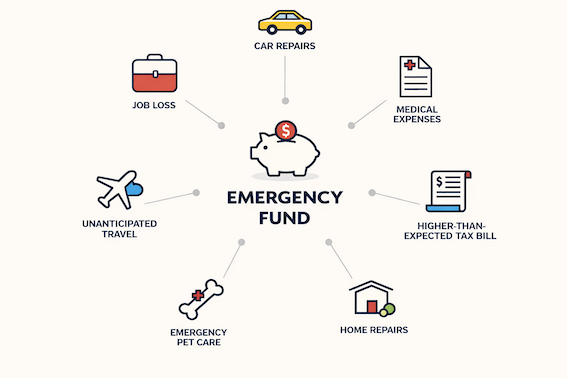
An emergency fund serves as a financial shield, protecting you from going into debt or depleting your long-term savings when unexpected expenses arise. Some benefits of having an emergency fund include:
-
Reduced financial stress
-
Avoidance of debt
-
Protection of long-term investments
-
Peace of mind
How Much Should You Save?
-
Monthly essential expenses (rent, utilities, food, transportation)
-
Job security and income stability
-
Dependents and responsibilities
Defining Your “Emergency”
One of the biggest pitfalls I see is people raiding their savings for things that aren’t actually emergencies. If you are going to commit to this, you need a rigid definition.
An Emergency is an unexpected event that:
-
Threatens your basic survival: Food, shelter, transportation to work, medical care.
-
Is urgent: It cannot wait until your next paycheck.
-
Is unplanned: You did not know it was coming.
What is NOT an emergency:
-
A “great deal” on a flat-screen TV.
-
Holiday gifts.
-
A vacation.
-
Car maintenance that is scheduled (like new tires you knew you needed months ago).
If you keep your fund safe from “lifestyle creep,” it will be there when the real disaster hits.
Step-by-Step Guide to Building Your Emergency Fund
Life is full of surprises—some exciting, others expensive. An emergency fund acts as your financial safety net, helping you handle unexpected costs like medical bills, car repairs, or sudden job loss without going into debt. If building one feels overwhelming, don’t worry. Breaking it into simple, manageable steps makes the process far more realistic and sustainable.
1. Understand Where Your Money Goes 📊
The first step is awareness. Track your monthly income and expenses to understand your spending habits. List fixed costs like rent, utilities, and groceries, along with variable spending such as dining out or subscriptions. This clarity helps you identify small areas where money can be redirected toward savings.
| Category | Action | Impact |
|---|---|---|
| 🏠 Fixed Expenses | Review bills & rent | Finds long-term savings |
| 🍔 Variable Spending | Cut non-essentials | Frees up quick cash |
| 💳 Subscriptions | Cancel unused services | Instant monthly boost |
2. Set a Realistic Emergency Fund Goal 🎯
Most experts recommend saving 3–6 months of essential expenses, but starting smaller is perfectly okay. Your first milestone could be $500 or $1,000. Reaching smaller goals builds confidence and momentum.
| Goal Level | Target Amount | Who It’s Best For |
|---|---|---|
| 🟢 Starter Fund | $500–$1,000 | Beginners |
| 🔵 Stability Fund | 3 months expenses | Steady income |
| 🟣 Full Cushion | 6 months expenses | Variable income |
3. Open a Dedicated Savings Account 🏦
Open a savings account at a bank that is not your main checking bank. This creates “friction.” If you have to transfer money from Bank A to Bank B (which takes 1–3 days), you are less likely to impulse-spend it.
Pro Tip: Look for a High-Yield Savings Account (HYSA). These currently pay much higher interest than standard savings accounts, meaning your money is literally making money while it sits there.
4. Automate Your Savings 🔁
Willpower is a finite resource. Do not rely on it. Set up an automatic transfer from your checking to your new savings account for the day after your payday.
-
Start small: If you can only afford $25 per paycheck, do $25. The habit is more important than the amount.
-
Increase incrementally: Every time you get a raise or pay off a small debt, increase your transfer by $10 or $20.
| Frequency | Amount | Annual Savings |
|---|---|---|
| Weekly | $25 | $1,300 |
| Biweekly | $50 | $1,300 |
| Monthly | $100 | $1,200 |
5. Start Small and Increase Gradually 🌱
Saving consistently matters more than saving a large amount right away. Begin with a comfortable contribution, then increase it as your financial situation improves—such as after a raise, bonus, or paying off a debt.
| Stage | Monthly Contribution | When to Increase |
|---|---|---|
| 🌱 Starting Point | $25–$50 | First month of saving |
| 📈 Growth Phase | $75–$150 | After cutting expenses |
| 🚀 Momentum Boost | $200+ | After raise or bonus |
| 🎯 Maintenance | Adjust as needed | Annually or life changes |
6. Boost Your Fund with Extra Income 💼
Adding even small streams of extra income can significantly speed up your emergency fund growth. The key is to treat this money as “found cash” and direct it straight into savings instead of lifestyle upgrades.
| Extra Income Source | Time Commitment | Potential Monthly Boost |
|---|---|---|
| 🧾 Freelance / Gig Work | Flexible hours | $100–$500 |
| 🛍️ Selling Unused Items | One-time effort | $50–$300 |
| 💳 Cash-Back & Rewards | No extra time | $20–$100 |
| 🧑🏫 Tutoring / Consulting | Evenings/weekends | $200–$600 |
| 🎁 Windfalls & Bonuses | Occasional | Varies |
7. Review and Adjust Regularly 🔍
Your emergency fund isn’t a “set it and forget it” goal. As your income, expenses, or lifestyle change, your savings plan should evolve to stay effective and relevant.
| Review Trigger | What to Check | Action to Take |
|---|---|---|
| 📆 Annual Review | Savings balance vs. goal | Increase or rebalance contributions |
| 💼 Job Change | Income stability | Adjust fund size (3–6 months) |
| 🏠 Major Life Event | Monthly expenses | Recalculate target amount |
| 💳 New Debt or Payoff | Cash flow changes | Redirect freed-up money |
| 🚨 Emergency Use | Fund depletion | Rebuild fund immediately |
Common Pitfalls to Avoid
As you navigate this journey, watch out for these traps:
-
The “Investment” Trap: Do not put your emergency fund in stocks, crypto, or long-term investments. If the market crashes the same week your car dies, you will be forced to sell at a loss. Your emergency fund belongs in cash (savings accounts or money market funds).
-
The “Borrowing” Trap: Never borrow from your retirement (401k or IRA) to fund your emergency savings. The tax penalties and lost growth are too expensive.
-
The “Comparison” Trap: Don’t look at social media and see people with $50,000 in savings and feel behind. You are only competing against your past self.
The Peace of Mind Dividend
Saving money for an emergency fund is arguably the most boring part of personal finance. It doesn’t get you a new car, a fancy vacation, or a cool gadget.
But it gives you something much more valuable: Autonomy.
When you have a fully funded emergency account, a bad boss can no longer hold your job hostage. A surprise car repair is just an inconvenience, not a financial tragedy. You stop making decisions based on fear and start making them based on your goals.
Start where you are. Even if you start with $10, start today. Your future self is already thanking you.
-
Cut unnecessary expenses
-
Sell unwanted items
-
Use the 50/30/20 rule (50% necessities, 30% discretionary, 20% savings)
-
Consider a tax-advantaged savings account
-
Keep your emergency fund liquid
Common Challenges and Solutions
-
Struggling to start: Begin with small, achievable goals.
-
Lack of motivation: Share your goals with a trusted friend or family member.
-
Emergency fund depletion: Rebuild by prioritizing savings.
Sources and References:
Disclaimer:
The information provided on MyAmericanSavings.us is for educational purposes only and should not be construed as financial, investment, or legal advice. Please consult with a licensed professional before making any financial decisions.