

Key Points
- Break the “Hunt” Cycle: Modern retail triggers dopamine during the anticipation of a purchase, not the item’s use. A 48-hour stop allows your brain’s reward center to recalibrate, helping you distinguish between a genuine need and a temporary neurological “itch.”
- Silence Digital Triggers: Your phone is a gateway for AI-driven spending. By disabling shopping and food delivery notifications, you create a digital sanctuary that prevents algorithms from targeting your willpower during high-stress or low-energy moments.
- Build Long-Term Friction: The reset isn’t just about two days of saving; it’s about building a permanent mental filter. Carrying the “72-hour rule” into your work week ensures you remain a conscious gatekeeper of your money rather than a reactive consumer.
In early 2026, the average American consumer triggers a financial transaction once every three hours during their waking day, according to the latest 2026 Consumer Spending Pulse. Between the one-click buy buttons on our phones and the biometric face-scans that approve our grocery deliveries, the friction of spending money has effectively vanished. This convenience comes at a high psychological cost: our brains are caught in a constant loop of dopamine hits triggered by the act of acquisition rather than the utility of the items we buy. This weekend, we are going to break that loop.
The 48-Hour No-Spend Weekend is not about deprivation or living like a hermit. Instead, it is a targeted neurological reset designed to clear the consumer noise from your life. By intentionally removing the option to spend for exactly two days, you force your brain to find satisfaction in what you already own, the people you already know, and the environment you already inhabit. It is a powerful antidote to the financial ghost subscriptions and impulse leaks that quietly drain our bank accounts every month.
 Related: Could You Go 48 Hours Without Spending Money? Let’s Find Out!
The Science of the Dopamine Loop and Retail Friction
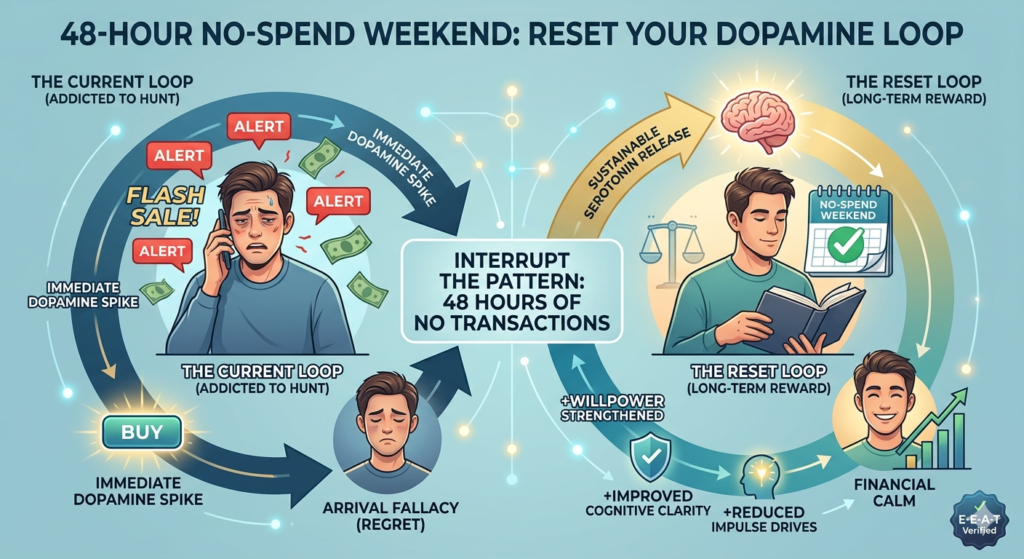
To understand why we spend, we have to understand the prefrontal cortex and its relationship with dopamine. In the 2026 retail landscape, companies use predictive AI to identify exactly when your willpower is at its lowest. Dopamine is often misunderstood as the molecule of pleasure, but in reality, it is the molecule of anticipation. When you see a notification for a limited-time sale on a pair of sneakers you recently searched for, your brain floods with dopamine not because you have the shoes, but because you are hunting them.
Once the purchase is made and the package arrives, the dopamine levels crash. This is known as the arrival fallacy. We spend because we are addicted to the hunt, not the item. By implementing a 48-hour hard stop, you allow your neural pathways to recalibrate. You are essentially telling your brain that the hunt is over for the weekend, which forces your neurochemistry to seek out slower, more sustainable forms of satisfaction like reading, conversation, or physical activity.
Step 1: The Friday Night Perimeter Sweep
The success of your no-spend weekend is decided on Friday evening. If you wake up Saturday morning with an empty fridge and a broken internet router, your challenge will end before lunch. The goal of Step 1 is to ensure that your survival needs are met so that your brain cannot use necessity as an excuse to break the rule.
Start by auditing your pantry and freezer. Most households have enough food to last several days, but we often ignore it because it requires effort to prepare. Plan your Saturday and Sunday meals around what you already have. This is the perfect time to get creative with that bag of lentils or the frozen spinach that has been sitting in the back of the freezer. By deciding your menu on Friday, you eliminate the decision fatigue that usually leads to a $40 delivery order on Saturday night.
Step 2: Digital De-Tuning and Notification Silencing
Your phone is the primary gateway for spending triggers. On Friday night, go into your settings and disable notifications for every shopping app, food delivery service, and social media platform that features shoppable ads. In the 2026 digital landscape, your attention is the product, and these apps are the salespeople.
If you don’t see the alert for a limited-time offer, the urge to spend never enters your mind. You are essentially creating a digital sanctuary. This is also a great time to check your retirement savings plan or your investment apps. Instead of spending money, spend time observing your progress. Seeing your net worth grow provides a much healthier dopamine hit than buying a pair of shoes you do not need.
Step 3: Finding Zero-Cost Entertainment
The biggest fear people have when starting a no-spend weekend is boredom. We have been conditioned to believe that doing something requires a ticket, a cover charge, or a receipt. To reset your dopamine, you must rediscover the joy of low-cost, high-connection activities.
Visit your local library. In 2026, libraries are no longer just for books; they offer free passes to state parks, museum entries, and even digital movie rentals. Alternatively, look into a seasonal wardrobe reset. Instead of buying new clothes, spend your Saturday morning organizing what you have, mending a loose button, or trying out new outfit combinations. You will often find that you already own the new look you were planning to buy.
Step 4: Dealing with Social Spending Pressure
One of the most difficult parts of a no-spend weekend is saying no to friends and family. Social spending is a major contributor to debt because we value our relationships more than our budgets. However, true friends will respect your financial boundaries if you are honest with them.
Instead of declining an invitation to go out for drinks, offer to host a board game night or a potluck using ingredients everyone already has in their kitchens. Most of your social circle is likely feeling the same 2026 economic pressures that you are, and they might actually be relieved to have a weekend that does not cost $100. By shifting the focus from going out to connecting, you strengthen your relationships without weakening your bank account.
A Case Study in Resistance: Sarah’s Saturday Struggle
To visualize how this looks in practice, let us look at Sarah, a 30-year-old graphic designer who decided to try her first no-spend weekend in March 2026. By Saturday at 2:00 PM, the initial excitement had worn off. Sarah felt a familiar itch to browse a home decor site because she was bored. Normally, she would have spent $60 on a new throw pillow she didn’t need.
Instead of opening the app, Sarah followed the Step 3 advice and went to her “Master List” of unfinished projects. She found a set of watercolors she had bought a year ago and never used. She spent three hours painting while listening to a free podcast. By the time 5:00 PM rolled around, the urge to shop had vanished. She realized the itch wasn’t for a pillow; it was for a creative outlet. This is the dopamine reset in action: replacing a passive purchase with an active creation.
Step 5: The Sunday Night Financial Audit
As your 48-hour challenge comes to a close, it is vital to document your success. Sit down with a notebook and list every purchase you did not make. This includes the morning latte, the mid-day Amazon browse, and the Sunday evening takeout.
Calculate the total savings. For the average American, a disciplined no-spend weekend can easily result in $150 to $300 in retained cash. This isn’t just saved money; it is money that can now be redirected toward high-impact goals, such as paying down high-interest debt or building an emergency fund. This visual proof of your willpower is the final dopamine hit of the weekend—one that leaves you feeling empowered rather than regretful.
The Monday Morning Recovery: Avoiding the Spending Binge
A common pitfall of the no-spend weekend is the Monday morning rebound. Much like a crash diet leads to a binge, a weekend of restriction can sometimes lead to a manic spending spree once the clock strikes Monday. To prevent this, you need a transition strategy.
When you see something you want to buy on Monday, implement the 72-hour rule. Put the item in your cart, but do not check out for three days. Usually, the clarity you gained during your no-spend weekend will remind you that the item is a want, not a need. By stretching the time between the impulse and the action, you maintain the healthy neural pathways you built over the weekend. You are no longer a slave to the notification; you are a conscious gatekeeper of your own capital.
The Long-Term Benefit of the 48-Hour Reset
The goal of this weekend isn’t to never spend money again. It is to regain control over the urge to spend. When you successfully navigate 48 hours without a transaction, you realize that you are the master of your finances, not the other way around. You start to see that the best things in life—quiet mornings, deep conversations, a clean home, and a walk in the park—do not have a price tag.
As you move back into your regular week, carry this friction with you. Before every purchase, ask yourself: am I buying this because I need it, or because my brain is looking for a quick dopamine fix? More often than not, the answer will be the latter. By practicing these resets once a month, you can effectively re-wire your brain to prioritize your future self over a temporary high.
Your Money, Your Life
In a world designed to keep you broke, being intentional is an act of rebellion. Every dollar you don’t spend on a whim is a dollar that can go toward your freedom. Whether you are saving for a home, planning for retirement, or just trying to get through the month without stress, the 48-hour dopamine reset is the most effective tool in your arsenal. Start your perimeter sweep this Friday, and discover just how much richer your life can be when you stop paying for the distractions.
Sources:
-
Consumer Spending Data: Statista 2026 Retail Analysis: Monthly Impulse Spending in the USA.
-
Dopamine and Retail Therapy: Journal of Behavioral Economics: Willpower and Financial Resilience.
-
Digital Consumption Trends: Deloitte 2026 Digital Media Trends Report.
-
Economic Outlook 2026: LendingTree / DepositAccounts 2026 Consumer Savings Report.
-
Retail Psychology: McKinsey & Company 2025-2026 Consumer Insights.
Disclaimer:
The information provided on MyAmericanSavings.us is for educational purposes only and should not be construed as financial, investment, or legal advice. Please consult with a licensed professional before making any financial decisions.