

American household debt hit a record $16.9 trillion at the end of 2022, up $2.75 trillion since 2019, according to the Federal Reserve. If you had to write that check it would read $16,960,000,000,000.
Source: Debt.org – Americans in Debt
📊 U.S. Household Debt Overview
| Debt Category | Approximate Amount (USD) |
|---|---|
| Total Household Debt | $18.8 Trillion |
| Credit Card Debt | $1.18 Trillion |
| Mortgage Debt | $12.80 Trillion |
| Auto Loan Debt | $1.64 Trillion |
| Student Loan Debt | $1.63 Trillion |
Sources: Debt.org -The Demographics of Household Debt In America
Experian.com -Average American Debt by Age, US State, Credit Score and Type in 2025
How to Save Money for Debt Repayment?
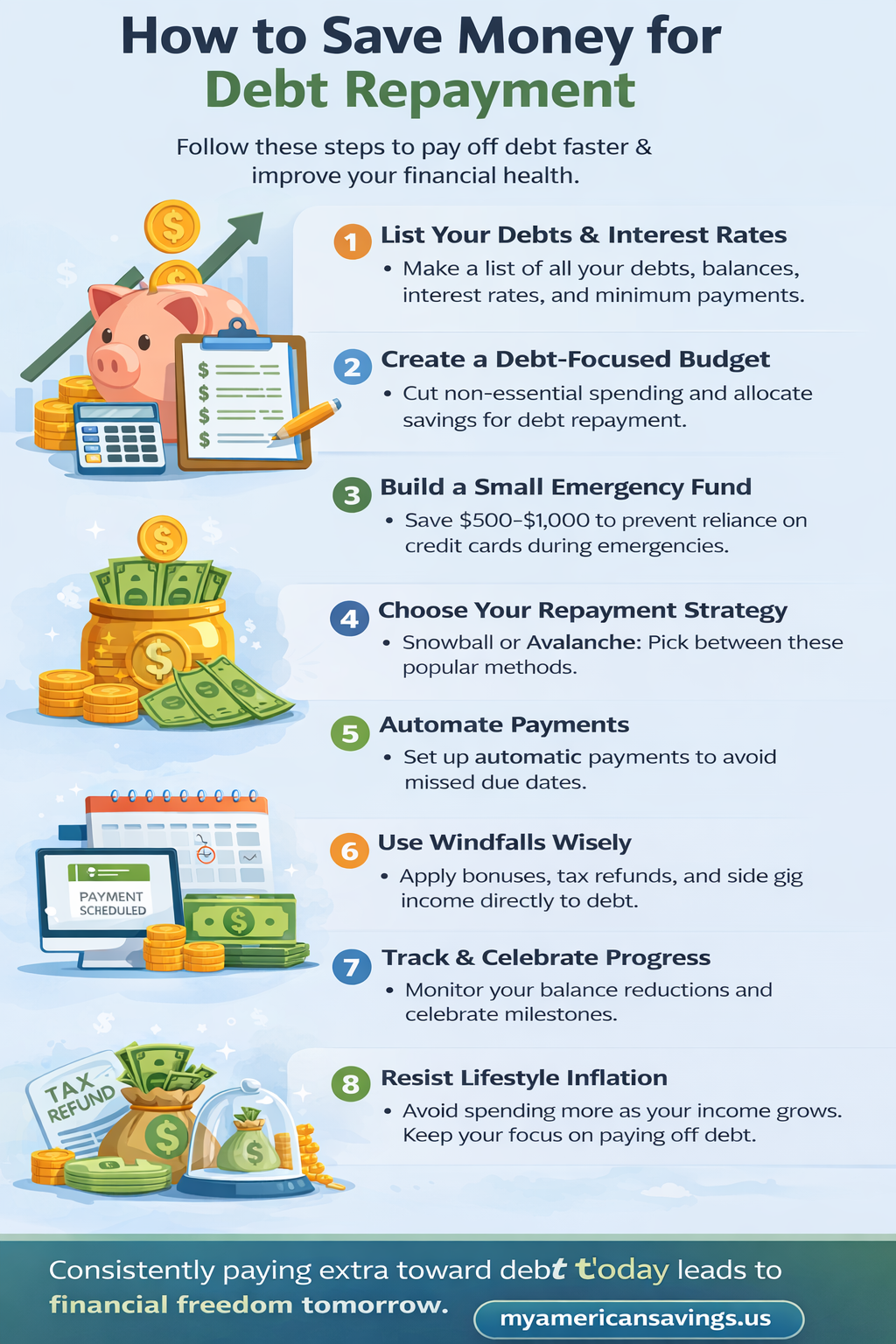
1. Understand Your Debt Clearly
Before you can save effectively, you need a complete picture of what you owe. List every debt, including:
-
Total balance
-
Interest rate
-
Minimum monthly payment
-
Due date
When you see everything in one place, it becomes easier to prioritize.
📊 Example Debt Overview Table
| Debt Type | Balance | Interest Rate | Minimum Payment |
|---|---|---|---|
| Credit Card A | $6,500 | 22% | $195 |
| Auto Loan | $14,000 | 6% | $320 |
| Student Loan | $18,000 | 5% | $210 |
| Personal Loan | $4,000 | 12% | $150 |
This visual breakdown helps you identify which debt is costing you the most in interest.
2. Create a Debt-Focused Budget
The next step is adjusting your budget to free up money for repayment. Start by calculating your monthly income, then subtract essential expenses like housing, utilities, groceries, and insurance.
Look for areas where you can reduce spending:
-
Dining out
-
Impulse purchases
-
Unused memberships
Even cutting $150–$300 per month can dramatically accelerate debt repayment.
📊 Sample Monthly Budget Adjustment
| Category | Before | After | Monthly Savings |
|---|---|---|---|
| Dining Out | $350 | $150 | $200 |
| Streaming Services | $75 | $30 | $45 |
| Shopping | $300 | $150 | $150 |
| Miscellaneous | $200 | $120 | $80 |
| Total Savings | $475 |
That $475 per month equals $5,700 per year applied directly toward debt.
3. Choose a Repayment Strategy
There are two popular strategies for saving and paying off debt:
Debt Avalanche Method
Pay off the highest-interest debt first while making minimum payments on others. This saves the most money long-term.
Debt Snowball Method
Pay off the smallest balance first to build motivation and momentum.
Both methods work — the key is consistency.
4. Build a Small Emergency Fund First
It may sound counterintuitive, but setting aside $500–$1,000 before aggressively attacking debt prevents you from relying on credit cards during emergencies. According to the Federal Reserve, many Americans would struggle to cover an unexpected $400 expense without borrowing.
This statistic reinforces the importance of having a financial cushion.
5. Automate and Stay Consistent
Automation removes emotion and forgetfulness from the equation. Set up automatic payments above the minimum amount whenever possible. This helps avoid late fees and keeps your progress steady.
Also consider:
-
Directing tax refunds to debt
-
Using bonuses for extra payments
-
Taking on short-term side work
-
Selling unused household items
Even occasional lump-sum payments can significantly reduce interest over time.
6. Understand the True Cost of Interest
High-interest debt grows quickly. Below is an example of how interest affects repayment:
📊 Credit Card Interest Impact Example
| Balance | Interest Rate | Minimum Payment | Time to Pay Off | Total Interest Paid |
|---|---|---|---|---|
| $6,000 | 22% | $180 | 4+ Years | $3,000+ |
| $6,000 | 22% | $400 | 18 Months | $1,100+ |
Paying more than the minimum cuts repayment time dramatically and saves thousands in interest.
7. Reduce Interest Where Possible
If your credit score allows, consider:
-
Balance transfer cards with 0% intro APR
-
Debt consolidation loans with lower interest
-
Refinancing high-interest loans
However, always review terms carefully and avoid accumulating new debt.
8. Track Your Progress Visually
Seeing progress can boost motivation. Create a simple payoff tracker.
📊 Debt Payoff Progress Example
| Month | Total Debt Balance | Amount Paid | Remaining Balance |
|---|---|---|---|
| January | $42,500 | $1,200 | $41,300 |
| February | $41,300 | $1,500 | $39,800 |
| March | $39,800 | $1,450 | $38,350 |
Watching the numbers decline reinforces positive financial habits.
9. Avoid Lifestyle Inflation
As income increases, it’s tempting to upgrade spending. Instead, direct raises and extra earnings toward debt until it’s eliminated. Maintaining your current lifestyle while increasing payments shortens repayment dramatically. Resisting lifestyle inflation allows you to build momentum and reduce financial stress faster. The discipline to prioritize debt today creates greater flexibility and wealth-building opportunities tomorrow.
10. Stay Motivated with Milestones
Set small goals along the way:
-
First $1,000 paid off
-
First credit card cleared
-
25% debt reduction
-
50% debt reduction
Celebrate progress affordably — not with new debt.
Why Saving for Debt Repayment Matters Now
With U.S. household debt at record highs according to the Federal Reserve Bank of New York, and credit card interest rates exceeding 20% per the Federal Reserve, delaying repayment can significantly increase long-term financial costs.
Official Data Sources:
These reports show that rising interest rates are making debt more expensive for millions of Americans. The sooner you begin saving intentionally for repayment, the more money you preserve for future goals like homeownership, retirement, and investments.
Debt Freedom Starts with a Simple Plan
Saving money for debt repayment is not about extreme sacrifice — it’s about intentional planning. By understanding your debt, creating a focused budget, choosing a repayment strategy, and staying consistent, you can reduce balances faster and save thousands in interest.
Small steps taken consistently create powerful results. Whether you start with $50 or $500 per month, what matters most is commitment. With discipline and a clear strategy, financial freedom is achievable — and every extra dollar saved brings you closer to it.